
Introduction
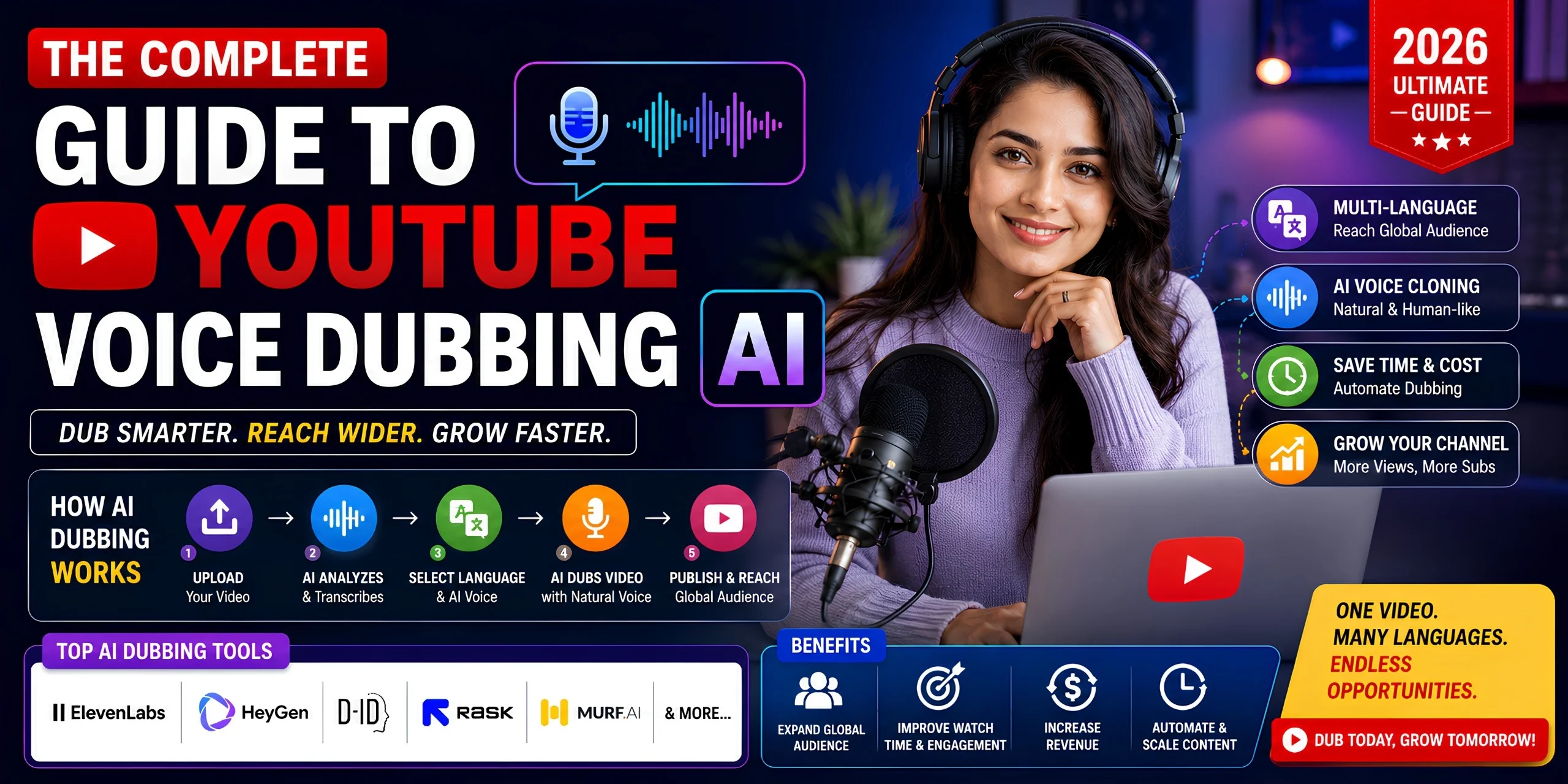
YouTube has become the world’s largest video platform, connecting creators with billions of viewers across different countries, cultures, and languages. Today, content is no longer limited to one region. A video created in India can be watched in Brazil, Germany, Japan, or South Africa within seconds.
However, language remains the biggest barrier.
Many creators lose millions of potential viewers simply because their content is not available in other languages. This is where AI YouTube dubbing changes everything.
With artificial intelligence, creators can now translate and dub their videos into multiple languages automatically, without hiring expensive voice artists or translators. This technology is transforming YouTube growth and global monetization.
In this guide, you will learn everything about AI dubbing, localization, SEO strategy, monetization, and how to build a powerful global channel.
Table of Contents
Introduction
What Is AI YouTube Dubbing?
Why Localization Is Essential for Global Growth
How AI Dubbing Works in YouTube Content
Benefits of Using AI for Video Localization
Choosing the Right AI Dubbing Tools
Step-by-Step Guide to AI YouTube Dubbing
SEO Strategy for Localized YouTube Videos
Monetization Opportunities with AI Dubbing
Common Mistakes to Avoid
Future of AI in YouTube Localization
Case Studies and Real-Life Success
Advanced Tips for Viral Growth
Final Thoughts and Conclusion
The Professional Guide to AI YouTube Dubbing: How to Localize Content and Grow Globally
1. What Is AI YouTube Dubbing?
AI YouTube dubbing is the process of using artificial intelligence to convert your original voice into different languages while keeping the same tone, emotion, and timing.
Unlike traditional dubbing, which requires human voice actors and studios, AI dubbing uses:
-
- Speech recognition
-
- Machine translation
-
- Voice cloning
-
- Neural voice synthesis
The result is a natural-sounding voice in multiple languages that matches your original video.
Modern AI tools can now recreate your voice and speak Spanish, French, Hindi, German, Arabic, and many other languages with high accuracy.
2. Why Localization Is Essential for Global Growth
Localization is more than translation. It means adapting your content to fit the culture, language, and expectations of international viewers.
When you localize your YouTube videos:
-
- You increase watch time because viewers understand you clearly.
-
- You improve engagement because people connect emotionally.
-
- You boost algorithm ranking because YouTube promotes content with higher retention.
-
- You expand monetization because advertisers pay more for global reach.
Statistics show that over 70% of YouTube watch time comes from non-English audiences. Ignoring localization means ignoring most of the internet.
3. How AI Dubbing Works in YouTube Content
AI dubbing follows a systematic process.
First, the AI software listens to your original audio and converts it into text using speech recognition.
Second, the text is translated into target languages using neural translation models.
Third, the translated text is converted into voice using AI voice synthesis.
Fourth, the new voice is synchronized with your video’s lip movement and timing.
Advanced tools also analyze emotions, pitch, and speed to make the voice sound human.
The entire process can happen in minutes instead of weeks.
4. Benefits of Using AI for Video Localization
AI dubbing offers several professional advantages.
Cost efficiency is the biggest benefit. Traditional dubbing can cost thousands of dollars per video, while AI tools charge a small monthly fee.
Speed is another major advantage. A multilingual video can be created in hours.
Scalability allows you to publish in 10–20 languages at once.
Consistency ensures that every video maintains the same voice and branding.
Accessibility improves because hearing-impaired and foreign viewers can enjoy your content.
These benefits make AI dubbing essential for modern creators.
5. Choosing the Right AI Dubbing Tools
Not all AI tools are equal. A professional creator must evaluate platforms carefully.
Good AI dubbing software should offer:
-
- High voice naturalness
-
- Multiple language support
-
- Lip-sync capability
-
- Custom voice cloning
-
- YouTube integration
-
- Copyright safety
-
- Export flexibility
Some tools specialize in entertainment, while others focus on education or business. Always test with free trials before committing.
6. Step-by-Step Guide to AI YouTube Dubbing
Step 1: Prepare Your Original Video
Use clear audio, minimal background noise, and proper pronunciation. AI works best with clean recordings.
Step 2: Upload to AI Platform
Upload your video or audio file to the dubbing software.
Step 3: Select Target Languages
Choose languages based on your audience analytics.
Common high-traffic languages include Spanish, Hindi, Portuguese, French, and Arabic.
Step 4: Customize Voice Settings
Adjust speed, tone, and emotion to match your personality.
Step 5: Generate Dubbing
Allow the AI to process your video.
Step 6: Review and Edit
Always check pronunciation and synchronization.
Step 7: Export and Upload
Upload the localized video or audio track to YouTube.
7. SEO Strategy for Localized YouTube Videos
SEO is critical for viral success.
For every language version, you must optimize:
-
- Title in local language
-
- Description with keywords
-
- Localized tags
-
- Translated captions
-
- Language-specific thumbnails
YouTube uses metadata to recommend videos to regional users.
Example:
-
- English Title: How to Make Money Online
-
- Spanish Title: Cómo Ganar Dinero en Línea
This increases regional discovery.
8. Monetization Opportunities with AI Dubbing
-
- AI dubbing multiplies your income streams.
-
- Ad revenue increases with international views.
-
- Affiliate marketing expands into new regions.
-
- Sponsorships grow because brands prefer global creators.
-
- Digital products sell internationally.
-
- Courses and memberships gain foreign subscribers.
-
- One video can now earn money from multiple countries.
9. Common Mistakes to Avoid
-
- Many creators fail due to avoidable mistakes.
-
- Using poor-quality AI voices reduces trust.
-
- Ignoring cultural sensitivity can cause backlash.
-
- Publishing without proofreading damages credibility.
-
- Over-translating slang creates confusion.
-
- Uploading without SEO optimization limits reach.
-
- Avoid these errors to maintain professionalism.
10. Future of AI in YouTube Localization
The future of AI dubbing is highly advanced.
Upcoming developments include:
-
- Real-time live dubbing
-
- Perfect lip matching
-
- Emotion-aware voices
-
- Personalized viewer language selection
-
- Interactive subtitles
Soon, viewers may choose their preferred language instantly. Creators who adapt early will dominate global markets.
11. Case Studies and Real-Life Success
Many channels have grown exponentially using AI dubbing.
-
- Educational channels doubled views within six months.
-
- Gaming creators gained Latin American audiences.
-
- Finance YouTubers expanded into Middle East markets.
-
- Motivational speakers reached European subscribers.
These examples prove the power of localization.
12. Advanced Tips for Viral Growth
To maximize results:
-
- Analyze regional trends regularly.
-
- Create language-specific playlists.
-
- Collaborate with local influencers.
-
- Test multiple thumbnails.
-
- Use community posts in different languages.
-
- Track retention per region.
Consistency is the key to long-term success.
Conclusion
AI YouTube dubbing is no longer optional. It is a strategic necessity for serious creators.
In a digital world where competition is intense, localization gives you a powerful advantage. With AI, you can speak to millions of viewers in their native language, build trust, increase engagement, and grow revenue.
By combining quality content, AI technology, and strong SEO, you can transform your channel into a global brand.
The creators who embrace AI today will lead tomorrow’s digital economy.
If your goal is viral growth, long-term income, and worldwide influence, AI dubbing is your gateway.
Start now. Adapt fast. Grow globally.