
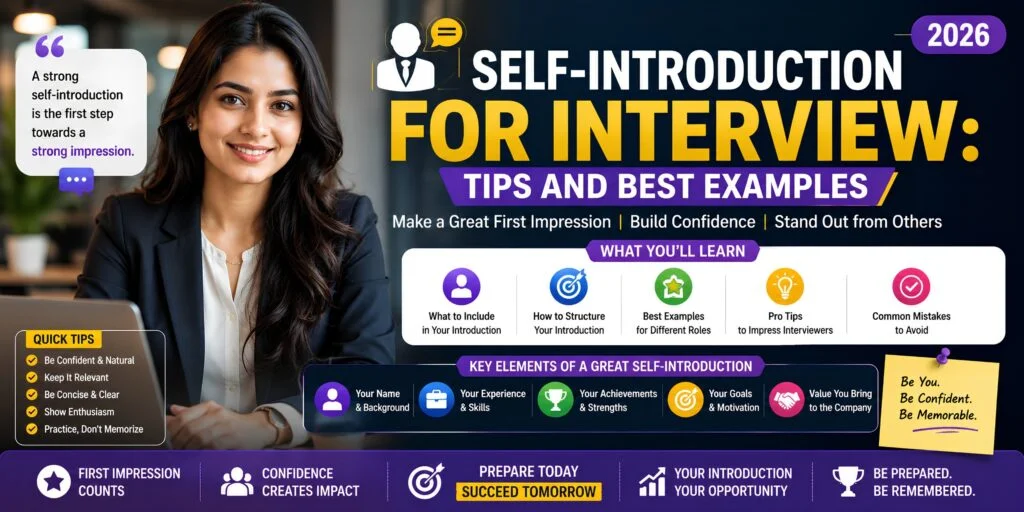
Introduction: The Power of First Impressions in Interviews
First impressions play a very important role in every job interview. In most cases, interviewers begin forming an opinion about a candidate within the first few minutes of meeting them. Your self-introduction becomes the foundation of this first impression. It sets the tone for the entire conversation and strongly influences how the interviewer perceives you.
When you meet someone for the first time, you naturally observe their confidence, tone of voice, body language, and way of speaking. These small details help you decide whether the person is trustworthy, capable, and professional. The same thing happens in interviews. A well-prepared self-introduction gives you a strong advantage over other candidates.
Your introduction is not just about stating your name. It is your opportunity to present your skills, background, attitude, and enthusiasm. When done correctly, it helps the interviewer understand why you are suitable for the position and why you deserve their attention.
Table of Contents
Steps to Introduce Yourself Confidently
Essential Elements of an Effective Self-Introduction
Self-Introduction Examples for Interviews
What Interviewers Look for in Your Introduction
Common Mistakes to Avoid
Why Communication Skills Matter
The Best Way to Conclude Your Introduction
How to Practice Effectively
Overcoming Nervousness
Conclusion
Frequently Asked Questions
Steps to Introduce Yourself Confidently
A confident self-introduction follows a simple but powerful structure. When you follow this structure, you sound natural, organized, and professional.
Start with a Polite Greeting
First, begin with a polite greeting. A simple “Good morning” or “Good afternoon, it’s nice to meet you” helps create a positive atmosphere. It shows respect and professionalism.
Mention Your Name and Background
Next, clearly mention your name and background. This gives context to the interviewer. For example, you can say, “My name is Rahul, and I come from a computer science background.” This immediately tells them where you are coming from.
Talk About Education or Work Experience
After that, talk briefly about your education or work experience. Mention your degree, institution, or professional experience. This shows your qualifications and prepares the interviewer for further discussion.
Highlight Key Skills and Achievements
Then, highlight your key skills and achievements. Focus only on skills that match the job role. For example, if you are applying for a marketing job, mention your experience in digital campaigns, analytics, or branding.
Express Enthusiasm for the Role
Finally, express your enthusiasm for the role. Let the interviewer know that you are genuinely interested. When you show excitement, it reflects motivation and seriousness.
When these steps are followed in a smooth manner, your introduction becomes clear, confident, and impressive.
Essential Elements of an Effective Self-Introduction
A strong self-introduction includes several important elements that work together to create a good impression.
Identity
Your identity is the first element. This includes your name and professional background. It helps the interviewer remember you.
Qualifications
Your educational and professional qualifications are the second element. This shows that you meet the basic requirements of the job.
Relevant Skills
Your relevant skills form the third element. These are the abilities that make you valuable to the company. Always choose skills that match the job description.
Achievements
Your achievements are the fourth element. These demonstrate what you have already accomplished. Even small achievements, when explained properly, can make a strong impact.
Attitude and Enthusiasm
Your attitude and enthusiasm are equally important. Interviewers prefer candidates who are positive, motivated, and eager to learn.
Confidence and Tone
Finally, your tone and confidence complete the introduction. Even strong content loses value if delivered without confidence.
A good self-introduction balances all these elements in a natural and professional way.
Self-Introduction Examples for Interviews
Example 1: Fresh Graduate
“Good morning. My name is Ankit, and I recently completed my degree in Business Administration from XYZ University. During my studies, I developed a strong interest in marketing and customer behavior. I also completed an internship at ABC Company, where I worked on social media campaigns and market research. This experience helped me improve my communication and analytical skills. I am excited to apply my knowledge in a professional environment and continue learning.”
This example works well because it shows education, practical experience, skills, and motivation in a simple way.
Example 2: Experienced Professional
“Hello, I’m Priya. I have over five years of experience in the IT industry, specializing in software testing and quality assurance. In my previous role at Tech Solutions, I managed testing projects for multiple clients and helped reduce system errors by 30%. I enjoy working in collaborative environments and solving complex problems. I am looking forward to contributing my experience to your organization.”
This example highlights experience, achievements, and professional goals clearly.
What Interviewers Look for in Your Introduction
When interviewers listen to your introduction, they are evaluating several things at the same time.
Confidence
They observe your confidence. A confident candidate appears more reliable and capable of handling responsibilities.
Relevance
They analyze the relevance of your background. They want to know if your skills and experience match the job requirements.
Professionalism
They notice your professionalism. This includes your language, attitude, and behavior.
Communication Skills
They assess your communication skills. Clear and structured speech shows that you can express ideas effectively.
Enthusiasm
They also check your enthusiasm. Passion for the role indicates long-term commitment.
Your self-introduction should be customized for each job to meet these expectations.
Common Mistakes to Avoid in Self-Introduction
Many candidates make small mistakes that reduce the impact of their introduction.
Speaking Too Much
One common mistake is speaking too much. Long and unnecessary details make you sound unprepared.
Sounding Memorized
Another mistake is sounding memorized. If you speak like a robot, it feels unnatural. Practice, but stay flexible.
Low Energy
Some candidates show low energy. A dull tone gives the impression of disinterest.
Irrelevant Information
Sharing irrelevant personal information is also harmful. Focus only on job-related points.
Lack of Preparation
Not preparing in advance is one of the biggest mistakes. Lack of preparation leads to confusion and nervousness.
Avoiding these mistakes makes your introduction more powerful.
Why Communication Skills Matter
Communication skills are essential in every profession. Your self-introduction is the first test of these skills.
Good communication shows confidence and leadership potential. Employers prefer people who can express ideas clearly.
It also proves that you can work well in teams. Teamwork depends on effective communication.
Strong communication helps in adapting to different work environments and cultures.
It also builds trust between you and your colleagues.
When your introduction reflects good communication, it increases your chances of selection.
The Best Way to Conclude Your Self-Introduction
Ending your introduction properly is just as important as starting it.
You should express interest in the role. For example, “I’m excited about this opportunity and eager to contribute.”
You can invite further discussion by saying, “I would love to explain how my skills fit your requirements.”
Always thank the interviewer for their time. This shows respect.
A positive ending creates a smooth transition to the next part of the interview.
How to Practice Your Self-Introduction Effectively
Practice helps you become confident and natural.
Record Yourself
Recording yourself allows you to analyze your voice, speed, and clarity.
Practice with Others
Practicing with friends or mentors gives you honest feedback.
Use a Mirror
Using a mirror helps you improve body language and facial expressions.
Tailor for Different Roles
Tailoring your introduction for different roles makes you more adaptable.
Mock Interviews
Participating in mock interviews gives real-life experience.
Regular practice reduces fear and improves performance.
Overcoming Nervousness During Self-Introduction
Nervousness is common, even among experienced candidates. The key is managing it.
Take Deep Breaths
Taking deep breaths before speaking helps calm your mind.
Pause Before Speaking
Pausing for a moment allows you to organize your thoughts.
Maintain Eye Contact
Maintaining eye contact shows confidence and engagement.
Observe Reactions
Observing the interviewer’s reactions helps you adjust your tone.
Positive Visualization
Positive visualization helps build confidence. Imagine yourself succeeding.
Prepare Backup Lines
Preparing backup lines helps if you forget something.
With practice, nervousness gradually disappears.
Conclusion
A strong self-introduction is the foundation of a successful interview. It helps you create a positive first impression and builds confidence in the interviewer’s mind.
It is not just about stating your name and experience. It is about presenting your personality, skills, motivation, and professionalism in a clear and engaging way.
By practicing regularly, improving communication skills, and avoiding common mistakes, you can master this important skill.
A good self-introduction brings you one step closer to career success.
Frequently Asked Questions
Q1: How long should a self-introduction be?
Ideally, it should be between 30 and 60 seconds. It should be short, clear, and meaningful.
Q2: Can I use humor in my introduction?
Yes, but only if it feels natural and professional. Avoid forced jokes.
Q3: Should I mention hobbies?
Only if they are relevant to the job or show useful skills like leadership or teamwork.
Q4: What if I forget part of my introduction?
Stay calm and continue with the main points. Confidence matters more than perfection.
Q5: How can I make my introduction stand out?
Use clear structure, highlight unique strengths, and show genuine enthusiasm.