
Introduction: Why Artificial Intelligence Matters Today
Artificial Intelligence, commonly known as AI, is no longer a futuristic idea found only in science fiction movies. It is already shaping how we live, work, learn, and communicate. From voice assistants on our phones to recommendation systems on YouTube and Netflix, AI silently influences our daily decisions.
What makes AI powerful is not just its ability to perform tasks, but its ability to learn, adapt, and improve over time. Businesses use AI to predict customer behavior, doctors use it to detect diseases early, and students use AI tools to learn faster.
Understanding artificial intelligence is no longer optional. It is becoming a basic digital skill, just like using the internet or email.
What Is Artificial Intelligence? (Simple Explanation)
Artificial Intelligence is the ability of a machine or computer system to perform tasks that normally require human intelligence.
These tasks include:
• Learning from experience
• Understanding language
• Recognizing images and patterns
• Making decisions
• Solving problems
In simple words, AI teaches machines how to think and act smartly.
Unlike traditional software that follows fixed rules, AI systems can improve their performance by analyzing data. The more data they receive, the better they become.
How Artificial Intelligence Works
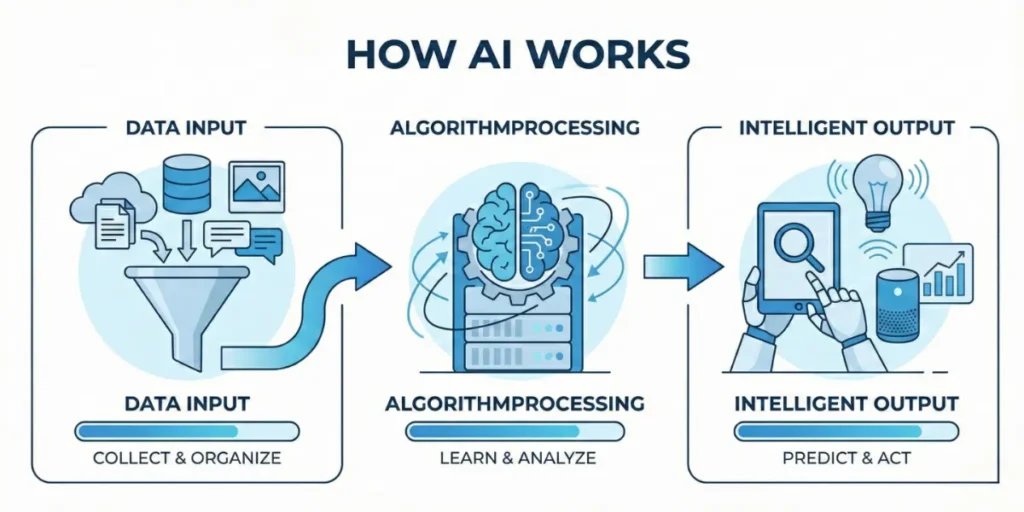
Artificial Intelligence works through a combination of data, algorithms, and computing power.
First, AI systems are trained using large amounts of data. This data may include text, images, videos, or numbers. Then, algorithms analyze this data to identify patterns and relationships.
The most common learning methods include:
Machine Learning:
Machines learn from past data and improve without being explicitly programmed.
Deep Learning:
A more advanced form of machine learning inspired by the human brain, using neural networks.
Natural Language Processing (NLP):
Allows AI to understand and generate human language.
Once trained, AI systems can make predictions, recommendations, or decisions based on new data.
Types of Artificial Intelligence
Artificial Intelligence can be divided into three main types based on capability:
Narrow AI (Weak AI):
Designed for specific tasks like voice assistants, recommendation systems, or facial recognition.
General AI (Strong AI):
Can perform any intellectual task a human can. This type does not yet exist.
Super AI:
A hypothetical form of AI that surpasses human intelligence. This remains a future concept.
Currently, all AI we use today falls under Narrow AI.
Real-Life Uses of Artificial Intelligence
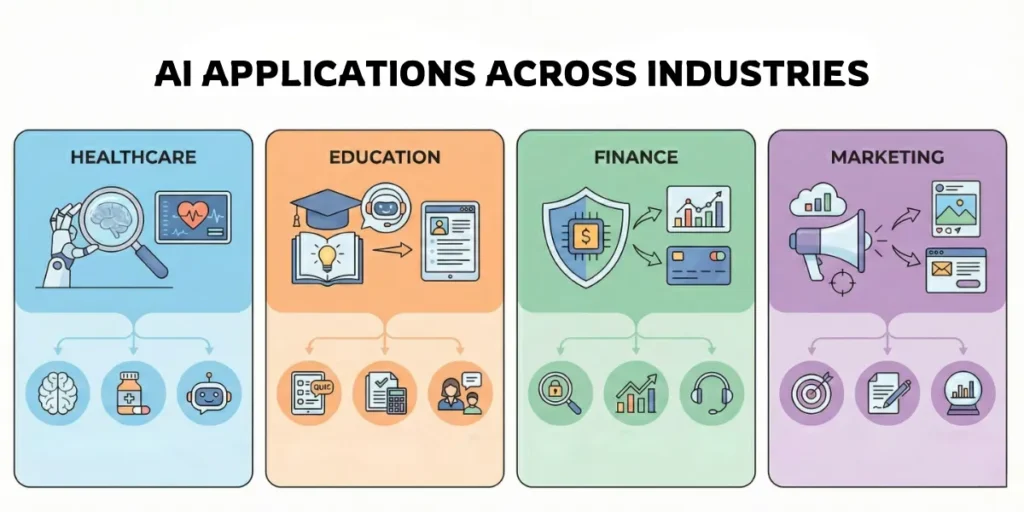
AI is already integrated into many industries:
Healthcare:
AI helps detect diseases, analyze medical images, and predict patient outcomes.
Education:
Personalized learning platforms adapt content based on student performance.
Finance:
Fraud detection, algorithmic trading, and credit scoring use AI.
Marketing:
AI analyzes user behavior to deliver personalized ads and content.
Entertainment:
Platforms like Netflix and Spotify use AI to recommend content.
Benefits of Artificial Intelligence
Artificial Intelligence offers several advantages:
• Improves efficiency and productivity
• Reduces human error
• Works 24/7 without fatigue
• Handles large amounts of data quickly
• Enhances decision-making
For businesses, AI leads to cost savings and better customer experiences. For individuals, it provides convenience and smarter tools.
Risks and Challenges of AI
Despite its benefits, AI also raises concerns:
• Job displacement due to automation
• Data privacy and security risks
• Bias in AI algorithms
• Overdependence on machines
• Ethical concerns
These challenges highlight the importance of responsible and ethical AI development.
AI in Jobs and Careers
AI is changing the job market, but it is also creating new opportunities.
Jobs growing due to AI include:
• Data Analyst
• AI Engineer
• Machine Learning Specialist
• Prompt Engineer
• AI Ethics Consultant
Instead of replacing humans completely, AI is shifting the demand toward skill-based and creative roles.
Future of Artificial Intelligence
The future of AI will focus on:
• Smarter automation
• Human-AI collaboration
• Ethical AI frameworks
• AI in sustainability and climate research
• Personalized digital experiences
AI will not replace humans, but humans who use AI will replace those who do not.
Conclusion: Understanding AI in a Human World
Artificial Intelligence is not about machines taking control, but about enhancing human potential. When used responsibly, AI becomes a powerful partner in solving complex problems, improving lives, and shaping a smarter future.
Learning how AI works today prepares us for the opportunities of tomorrow. The key is not to fear AI, but to understand it, adapt to it, and use it wisely.



Leave a Reply