
The Golden Age of Indian Cinema (1950–1970)
The 1950s and 60s — which are mostly referred to as the Golden Age of Indian cinema — are the years when films completely filled with people’s hearts and the whole experience was more personal. Old clips of Pyaasa and Shree 420 are some of the sweetest memories of mine,; even now, the way they portray human emotions is very much up to date. The likes of Guru Dutt, Bimal Roy, and Raj Kapoor didn’t just produce films — they were making dramas that reflected the society, the dreams, and the hardships of the common man.
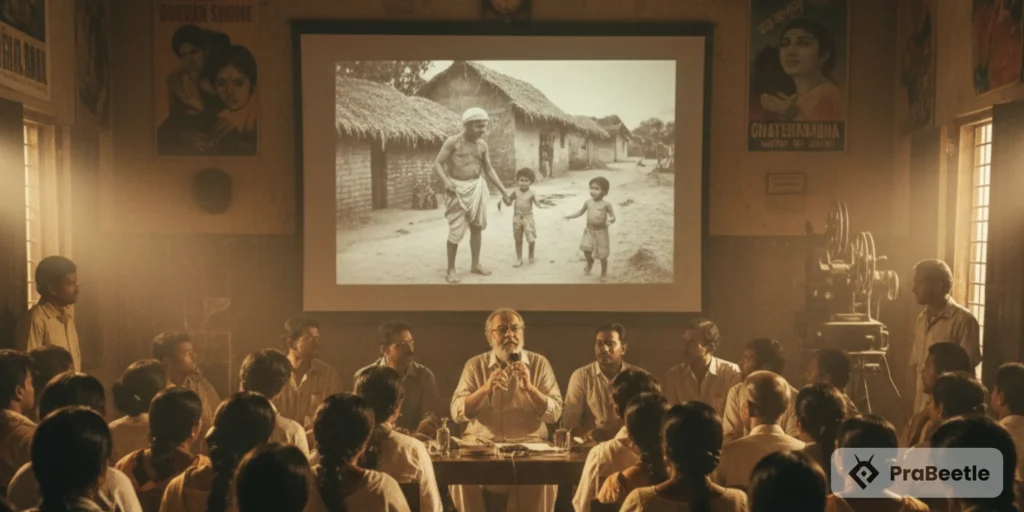
Although Bengali cinema had got its share of limelight in the form of Satyajit Ray’s Pather Panchali which is a very well praised and appreciated film by world audience.The realism, the delicacy, the capturing of little moments in a village – all of these together make it poetry on screen. Bollywood, on the other hand, was producing vibrant loves, and catchy songs, subsequently reinforcing the idea that commercial success and artistic depth could co-exist.
The regional cinemas of Tamil, Telugu, and Malayalam meanwhile were not side tracking their ways.They dealt with storytelling, and social themes while being technical and creative at the same time. It is a fact that filmmakers were able to make such influential films even without the modern technology and the likes of today’s advanced gadgets, which I find quite interesting. And the music! The songs composed by S.D. Burman and Shankar-Jaikishan are such that they have not only remained in our minds, but also, they have been haunting us for decades.|
Parallel Cinema and Regional Development (1970 – 1990)
The 1970s brought a shift. Moviemakers started playing with realism in parallel cinema as it was called. These films were not purely entertainment based, but they dealt with the social issues in question. I remember watching Ankur in which I perceived Ankur as a student and was surprised at how caste and power relationship were realistically dealt with. Shyam Benegal and Govind Nihalani among the film makers created such movies that you found yourself thinking even after the credits had been rolled.
Local movies also thrived. Tamil movies were geared towards topics and social relevance, Telugu movies geared towards folklore and Malayalam movies became the definition of realism. My experience when watching these films has given a new understanding to how Indian cinema is so different. It was not about Mumbai or Bollywood anymore, nation stories were spoken in all languages in the villages and in the large cities.
Commercial Cinema Boom (1990–2000)
The 1990s were another phase – giant-budget colorful and star-driven films were in the limelight. The filmmakers like Yash Chopra and Karan Johar brought romance to the new dimension. I have been introduced to Shah Rukh Khan and Madhuri Dixit in films and to me such films did not appear to be a simple narration, but a cultural phenomenon.
Cinemas in the region did the same. The Tamil, Telugu, and Malayalam films started to merge the stories of the local community and heavy production. Movies such as Baashha and Swarna Kamalam demonstrated that even regional films could be as epic and as popular. It is also the period when music, fashion and dialogues were represented in ordinary culture people quoted movies, hummed songs and even dressed up like their favorite stars.
Multiplexes and Technological Advances (2000–2010)
The technology of multiplexes and early 2000s were introduced. Suddenly, one had an option: mainstream blockbusters, an independent film or local gems. I remember I had once been to a multiplex in Mumbai and found out that I could watch a Tamil film with a Hindi one, something that could not be heard of when I was a child.
Small budgeted movies also had a chance to compete with digital filmmaking. The reflection of modern India, its problems, expectations, and contradictions was the mirror image of such movies like Lagaan and Rang De Basanti. As I was watching these films I realized that cinema was no longer just a form of entertainment, a form of communication with the society.
OTT and Streaming Boom (2010–2020)

The 2010s were a time of big change. Indian movies were made available to the international market by the streaming sites, Netflix, Amazon Prime, and Hotstar. As a person, I came to hear about Malayalam movies on the Netflix and was fascinated with their storyline, the plot of which I would never face in my local cinemas.
The presence of such series as Sacred Games, and the fact that Indian movie, such as The Lunchbox, was also able to compete at the international level provided evidence of this. Independent filmmakers did not require huge studios anymore – creativeness became the money. Genres and stories which could not be presented in the traditional film industry could now be explored.
The Modern Era Now (2025–Today)
Indian movies these days? They’re all over the place – risky, different, and trying new stuff. The movies such as RRR, Kantara, and Article 15 demonstrate how regional cinema can be viewed by the entire world. I have observed how technology VFX and animation and digital distribution enables filmmakers to narrate ambitious stories without losing cultural authenticity.
Movies these days seem to be doing a much job better when it comes to gender equality and social issues. They’re also taking more risks with how they tell stories. Critics are getting pickier, so directors are bringing their A-game with all sorts of creative and thought-provoking ideas.This is an exhilarating time to watch movies because it is now possible to have stories of every part of India taking their place in world scene.
Conclusion
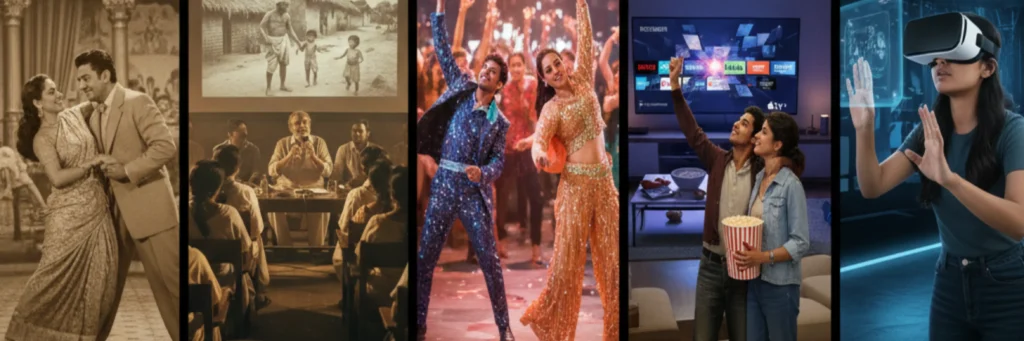
Since the silent movies, Indian movies have continuously changed into the international streaming successes. The most interesting fact is that it mirrors society, shapes culture, and entertains at the same time. Bollywood and regional movies together? It’s like a bright, lively party. When I watch, I’m not just seeing a story. I’m seeing India itself – its past, its different sides, and what makes it tick.
Indian movies? They’re more than just something on a screen. They’re like a living, breathing record of who we are. And it’s only going to get better. These stories will keep people hooked, teach them things, and get them inspired for ages.




Leave a Reply