
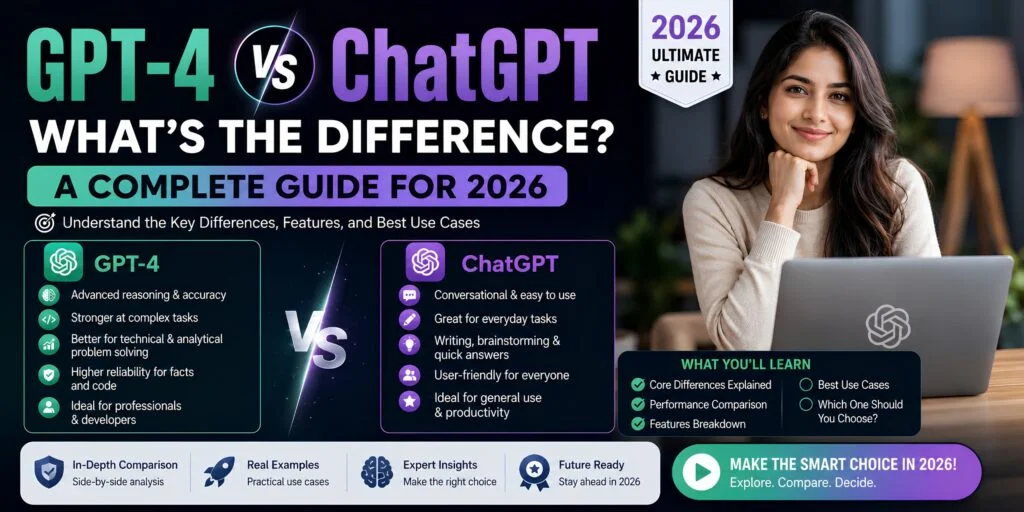
You’ve probably heard people use GPT-4 and ChatGPT interchangeably. However, many users don’t realize that one is an AI model while the other is the platform that delivers it. In this guide, you’ll learn the exact differences, capabilities, pricing, and use cases so you can confidently choose the right AI solution in 2026.
Key Takeaways
- GPT-4 is a large language model developed by OpenAI, whereas ChatGPT is the conversational application that gives users access to AI models.Understanding this distinction helps avoid confusion when selecting AI tools for work, research, or content creation.
- ChatGPT supports multiple AI models depending on the plan and availability. Free and premium users may experience different capabilities, response speeds, and advanced features.
- GPT-4 delivers stronger reasoning, coding, and multimodal capabilities than earlier generations. This makes it suitable for developers, researchers, marketers, and business users who need more advanced outputs.
- ChatGPT provides an easy-to-use interface for writing, coding, brainstorming, and research tasks. Most users interact with GPT models through ChatGPT instead of directly accessing the underlying model.
- AI assistants such as Grok, Gemini, Claude, and Microsoft Copilot serve different purposes and complement each other. Choosing the right tool depends on your goals, budget, and workflow requirements.
- Understanding AI terminology helps users make better decisions. Knowing the difference between models and applications prevents unnecessary confusion and subscription mistakes.
What Is the Difference Between GPT-4 and ChatGPT?
GPT-4 and ChatGPT are not competitors; GPT-4 is the underlying AI model, while ChatGPT is the application that delivers AI interactions.
Many people assume GPT-4 and ChatGPT are the same because they often interact with GPT models through ChatGPT. However, they serve different purposes. GPT-4 is the engine responsible for generating responses, while ChatGPT provides the interface that makes those responses accessible.
For example, just as an engine powers a car, GPT-4 powers AI interactions while ChatGPT acts as the vehicle users drive every day.
Why Are GPT-4 and ChatGPT Often Confused?
The confusion exists because users typically experience GPT-4 through ChatGPT. Terms like “ChatGPT-4” and “GPT-4 ChatGPT” are commonly used interchangeably, even though they refer to different layers of the same ecosystem.
Simple Analogy
| Component | Real-World Example |
| GPT-4 | Engine |
| ChatGPT | Car |
| User | Driver |
| OpenAI | Manufacturer |
Why Understanding GPT-4 vs ChatGPT Matters
Understanding the difference between GPT-4 and ChatGPT helps users choose the right tools, features, and subscription plans.
According to Statista 2025, generative AI adoption continues to grow rapidly across industries. Users increasingly depend on AI assistants for writing, coding, research, and productivity. Knowing whether you need a model or a chatbot platform can save both time and money.
Benefits of Understanding the Difference
Better purchasing decisions become easier because users understand what they are paying for. Many people assume they are subscribing to GPT-4 directly when they are actually subscribing to ChatGPT Plus.
Tool selection improves significantly when users know the strengths of each platform. Developers may need API access, while casual users only need a conversational assistant.
Productivity increases because the right AI tool matches specific workflows. Students, marketers, and programmers have different requirements.
What Is GPT-4?
GPT-4 is a large language model developed by OpenAI that powers advanced reasoning, coding, and multimodal AI capabilities.
GPT-4 represents a major advancement over earlier language models. It understands context better, provides more accurate answers, and supports complex tasks across many industries.
Features of GPT-4
Advanced Reasoning
GPT-4 solves difficult problems with improved logical understanding. It performs well in coding, analysis, and technical writing tasks.
Multimodal Capabilities
GPT-4 can understand text and images, making it useful for content creators, researchers, and developers.
Improved Accuracy
Compared with GPT-3.5, GPT-4 reduces hallucinations and produces more reliable outputs.
Common Use Cases of GPT-4
- Content writing and SEO optimization.
- Software development and debugging.
- Data analysis and research.
- Educational assistance and tutoring.
- Business automation and customer support.
What Is ChatGPT?
ChatGPT is an AI chatbot platform that provides access to different OpenAI models through a conversational interface.
Unlike GPT-4, ChatGPT is what users interact with daily. It simplifies AI usage by offering chat-based conversations, voice capabilities, file uploads, image generation, and coding assistance.
Features of ChatGPT
User-Friendly Interface
ChatGPT makes advanced AI accessible to beginners and professionals alike.
Multiple Models
Depending on subscription plans, users may access different models and capabilities.
Productivity Tools
ChatGPT supports writing, coding, brainstorming, summarization, and research tasks.
GPT-4 vs ChatGPT Side-by-Side Comparison
GPT-4 and ChatGPT serve different roles within the OpenAI ecosystem.
| Feature | GPT-4 | ChatGPT |
| Type | AI Model | Application |
| Purpose | Generate intelligence | Provide interface |
| Accessibility | API and products | Website and apps |
| Coding Ability | Excellent | Depends on model |
| User Experience | Technical | User-friendly |
| Pricing | API-based | Free and paid plans |
| Ideal Users | Developers and enterprises | General users |
GPT-4 vs GPT-3.5 vs GPT-4 Turbo vs GPT-4o vs GPT-5
GPT-4 vs GPT-3.5
GPT-4 offers stronger reasoning and improved accuracy compared with GPT-3.5.
GPT-4 vs GPT-4 Turbo
GPT-4 Turbo provides faster responses and lower operational costs.
GPT-4 vs GPT-4o
GPT-4o combines text, image, and voice capabilities with faster responses compared with earlier GPT-4 versions.
GPT-4 vs GPT-5
GPT-5 introduces further improvements in reasoning, memory, and agent capabilities, making it more powerful for complex workflows.
Pricing, Free Access, and Premium Plans
Pricing depends on whether users need basic AI access or advanced features.
Free Plan
The free plan offers access to essential capabilities and basic AI assistance.
ChatGPT Plus
ChatGPT Plus provides subscribers with access to more advanced AI models and additional features compared with the free plan.
API Pricing
Developers and businesses can integrate GPT models into applications through API access.
Best Alternatives to ChatGPT and GPT-4
AI assistants such as Grok AI, Gemini, Claude, and ChatGPT serve different workflows and complement one another rather than replacing each other.
Grok AI
Developed by xAI, Grok focuses on real-time information and social integration.
Google Gemini
Gemini integrates tightly with Google Workspace and Android ecosystems.
Claude AI
Claude emphasizes safety, long-context understanding, and document analysis.
Microsoft Copilot
Copilot integrates AI into Microsoft Office and Windows productivity tools.
Tools and Practical Applications
Content Creation
Writers can use ChatGPT for blog writing, SEO research, and brainstorming.

Software Development
Developers use GPT models for debugging and code generation.

Research and Education
Students use AI assistants for summaries, explanations, and learning.
What’s Next: How to Choose the Right AI Assistant
Choosing the right AI assistant depends on your goals, budget, and preferred workflow.
Choose GPT-4 If
- You require advanced reasoning.
- You need API integrations.
- You perform technical tasks frequently.
Choose ChatGPT If
- You want a simple interface.
- You need writing assistance.
- You prefer an all-in-one productivity platform.
Explore Alternatives If
- You use Google services extensively.
- You need long-context document analysis.
- You prefer real-time social insights.
Conclusion
GPT-4 and ChatGPT complement different user needs rather than competing against each other. GPT-4 provides the intelligence, while ChatGPT delivers a user-friendly experience. Understanding this distinction helps users choose the right AI tools, maximize productivity, and make informed decisions as AI technology continues to evolve.