
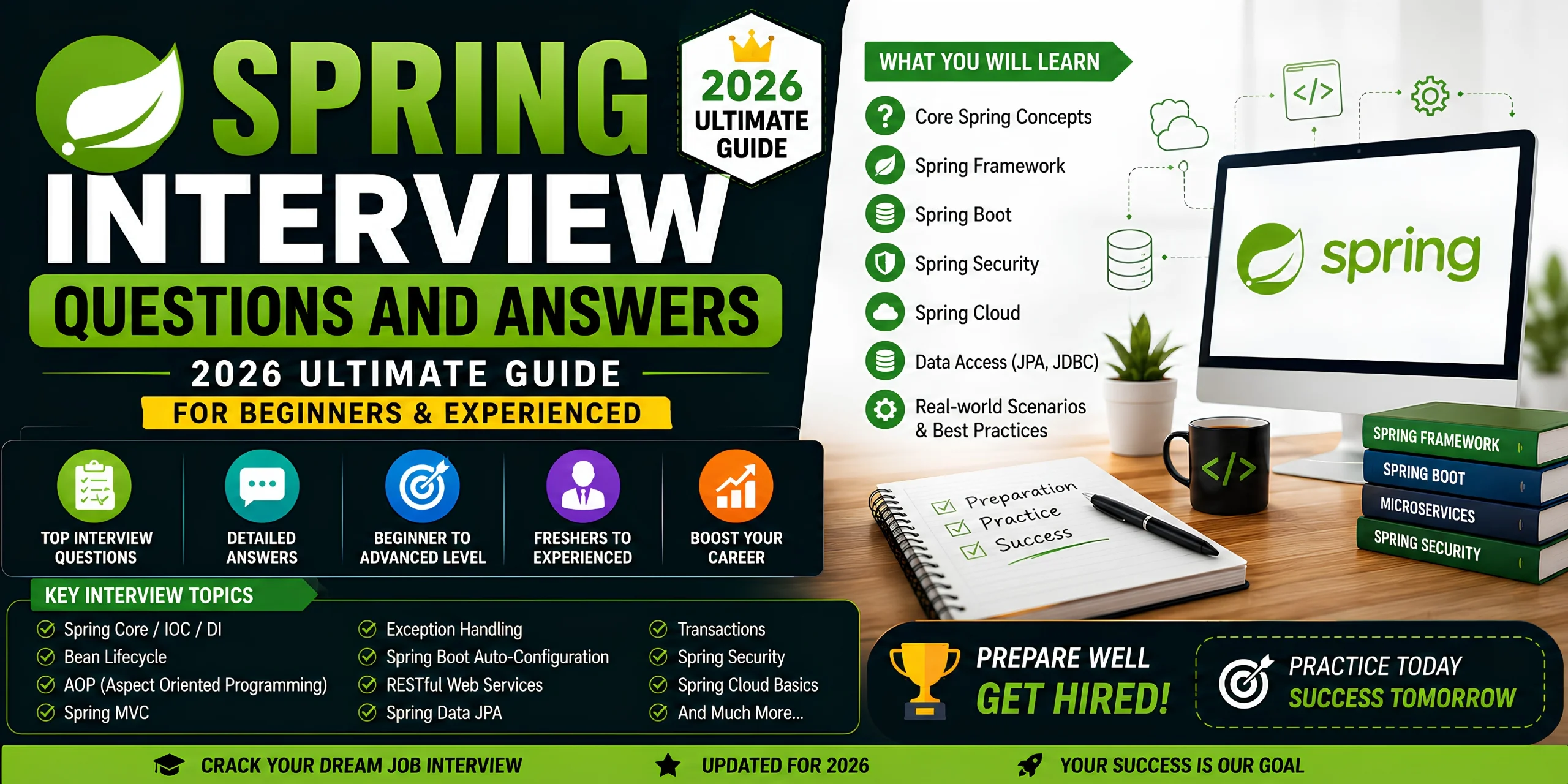
You’ve probably seen countless Spring interview questions online—but many lack clear answers or real-world context. What most candidates miss is how to explain concepts in a way interviewers actually expect. In this guide, you’ll learn the most important Spring interview questions and answers, explained simply and practically.
Key Takeaways
- Spring interview questions test both theoretical knowledge and real-world application skills.
- Core topics include IoC, Dependency Injection, AOP, Spring Boot, and REST APIs.
- Understanding concepts with examples is more important than memorizing answers.
- Spring Boot simplifies development with auto-configuration and embedded servers.
- Most interviews include scenario-based and project-related questions.
- Strong answers combine definition + example + real-world use case.
What Is Spring and Why Is It Used?
Spring is an open-source Java framework used to build scalable, enterprise-level applications with simplified development processes.
First, Spring provides features like Dependency Injection (DI) and Inversion of Control (IoC) to reduce code complexity. For example, instead of manually creating objects, Spring manages them automatically.
Second, it supports modular development. For example, developers can use Spring MVC for web apps and Spring Boot for microservices.
Third, it is widely adopted. Spring is used in enterprise applications due to its flexibility and performance.
“how AI works in simple terms” → AI basics article
Quotable insight: Spring simplifies Java development by managing infrastructure so developers can focus on business logic.
Why Are Spring Interview Questions Important?
Spring interview questions are important because they evaluate your ability to build real-world Java applications.
First, companies rely heavily on Spring for backend systems. For example, many enterprise applications use Spring for scalability.
Second, interviews test both knowledge and experience. For example, you may be asked to explain how you used Spring in a real project.
Third, job demand is strong. There are thousands of job openings for Spring developers in India.
“keyword research strategy guide” → SEO guide
What Are the Most Common Spring Interview Questions and Answers?
Common Spring interview questions and answers cover core concepts like DI, IoC, beans, AOP, and Spring Boot.
1. What Is Dependency Injection (DI)?
Dependency Injection is a design pattern where dependencies are provided externally instead of being created inside the class.
For example, instead of creating a database object inside a class, Spring injects it automatically.
Benefit: Improves testability and reduces tight coupling.
2. What Is Inversion of Control (IoC)?
Inversion of Control means the control of object creation is transferred from the developer to the Spring container.
For example, Spring manages object lifecycle instead of the programmer.
3. What Are Spring Beans?
Spring beans are objects that are managed by the Spring IoC container.
For example, any class annotated with @Component becomes a Spring bean.
4. What Is Spring Boot?
Spring Boot is an extension of Spring that simplifies application development by providing auto-configuration and embedded servers.
For example, you can run a web application without configuring Tomcat manually.
5. What Is AOP in Spring?
Aspect-Oriented Programming (AOP) is used to separate cross-cutting concerns like logging and security.
For example, you can log method execution without modifying business logic.
6. What Is Autowiring?
Autowiring automatically injects dependencies into a Spring bean.
For example:
@Autowired
private UserService userService;
7. What Are Bean Scopes in Spring?
Bean scope defines the lifecycle and visibility of a bean.
Common scopes:
- Singleton (default)
- Prototype
- Request
- Session
8. What Is Spring MVC?
Spring MVC is a web framework used to build web applications and REST APIs.
For example, it follows the Model-View-Controller design pattern.
9. What Is the Spring Bean Lifecycle?
Spring bean lifecycle includes instantiation, initialization, and destruction.
For example:
- Bean created
- Dependencies injected
- Bean initialized
- Bean destroyed
10. What Is the Difference Between Spring and Spring Boot?
Spring is a full framework, while Spring Boot is a simplified version that reduces configuration.
| Feature | Spring | Spring Boot |
|---|---|---|
| Configuration | Manual | Auto |
| Server | External | Embedded |
| Setup | Complex | Simple |
How Can I Answer Spring Interview Questions Effectively?
You can answer Spring interview questions effectively by using a structured approach: definition + example + use case.
Step-by-Step Method
- Start with a clear definition
- Give a simple example
- Explain real-world usage
For example:
- Definition → “DI is…”
- Example → “Spring injects…”
- Use case → “Used in large apps…”
“voice over tips for beginners” → guide]
Quotable insight: The best interview answers combine theory with practical experience.
What Are Scenario-Based Spring Interview Questions?
Scenario-based Spring interview questions test your real-world problem-solving ability.
Examples:
- How do you handle exceptions in Spring Boot?
- How do you optimize performance?
- How do you design REST APIs?
For example, you may explain using @ControllerAdvice for global exception handling.
Interviews often include project-based discussions.
What Are the Most Important Spring Boot Interview Questions?
Spring Boot interview questions focus on auto-configuration, microservices, and production-ready features.
Key Questions
- What is
@SpringBootApplication? - How does auto-configuration work?
- What is Spring Boot Actuator?
- How do you build microservices?
best AI tools for content creation → AI tools
What Are Common Mistakes to Avoid in Spring Interviews?
Common mistakes include giving theoretical answers without examples and ignoring real-world scenarios.
- Memorizing answers without understanding
- Not explaining use cases
- Weak knowledge of Spring Boot
- Ignoring project experience
Use Cases and Practical Applications of Spring
Spring is widely used to build enterprise applications, REST APIs, and microservices.
Enterprise Applications
First, Spring handles large-scale systems efficiently.
REST APIs
Second, Spring MVC is used to build APIs.
Microservices
Third, Spring Boot simplifies microservices architecture.
Preparing for Spring interviews involves consistent practice and real-world application.
Action Plan
- Learn core concepts deeply
- Practice 50+ questions
- Build projects using Spring Boot
- Prepare real examples
“content creation workflow checklist” → productivity guide
Conclusion
Spring interview questions and answers help you prepare for real-world development roles by strengthening both knowledge and practical skills.
First, focus on understanding core concepts. Second, practice explaining them clearly. Third, connect everything to real-world use cases.
Ultimately, success in interviews comes from clarity, confidence, and practical experience.