
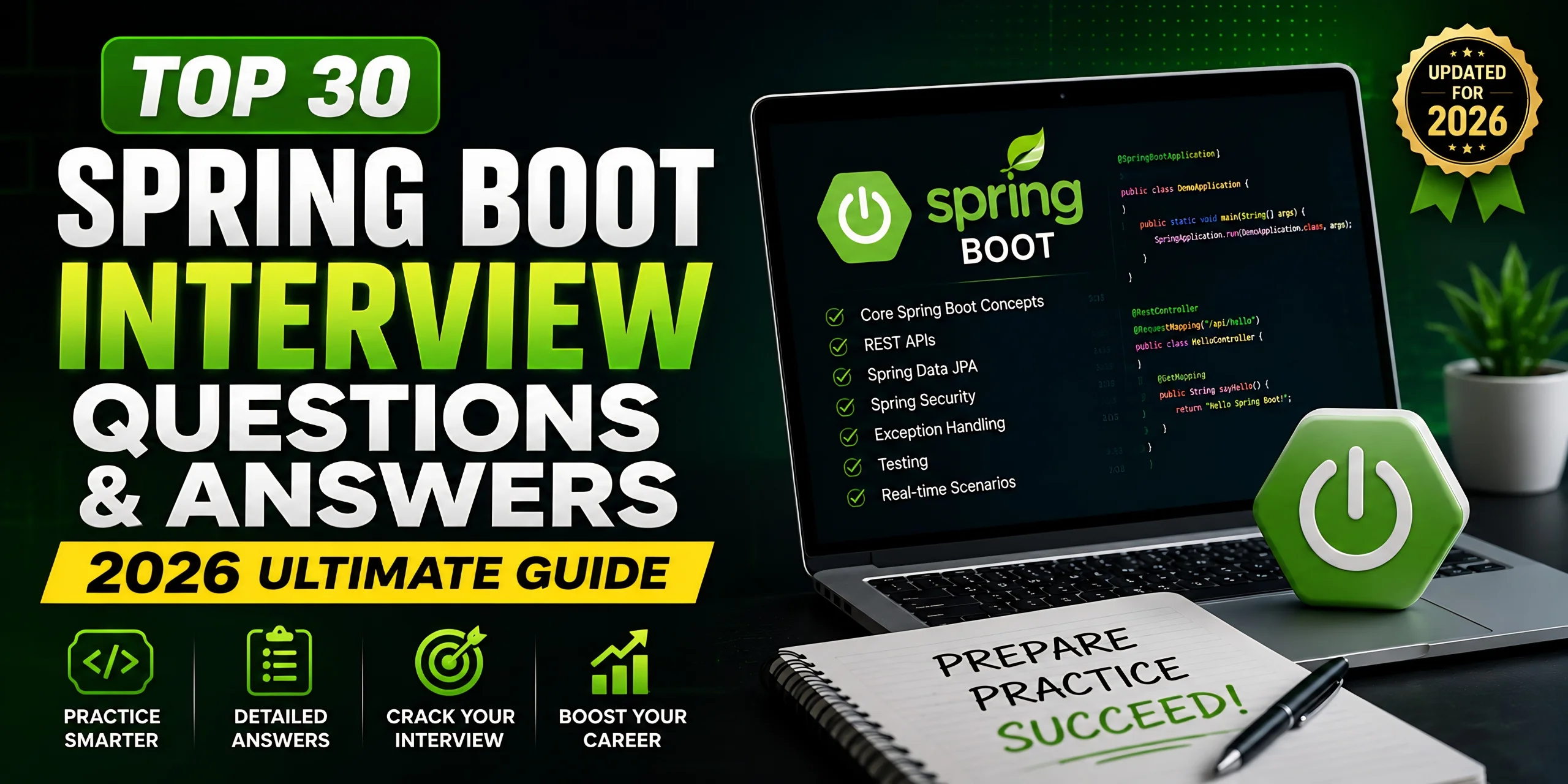
You’ve probably seen many Spring Boot interview question lists—but most are incomplete or lack clear answers. What most candidates miss is how to prepare across all levels—from basic to advanced and scenario-based. In this guide, you’ll get the top 100 Spring Boot interview questions and answers to help you confidently crack any interview.
Key Takeaways
- Spring Boot interview questions cover core, intermediate, and advanced topics.
- Most interviews include real-world and scenario-based questions.
- Spring Boot simplifies development using auto-configuration and embedded servers.
- Microservices and REST APIs are critical areas in interviews.
- Understanding concepts with examples is key to success.
- Demand for Spring Boot developers remains high in 2026.
What Is Spring Boot and Why Is It Used?
Spring Boot is a Java-based framework used to build stand-alone, production-ready applications with minimal configuration.
First, it simplifies development using auto-configuration and embedded servers. For example, you can run applications without deploying to external servers.
Second, it supports microservices architecture. For example, developers use Spring Boot to build scalable APIs quickly.
Third, it reduces development time significantly. This allows teams to focus on business logic instead of boilerplate code.
“how AI works in simple terms” → AI basics article]
Quotable insight: Spring Boot enables rapid application development with minimal configuration.
Why Are Spring Boot Interview Questions Important?
Spring Boot interview questions are important because they evaluate your ability to build scalable backend systems.
First, Spring Boot is widely used in enterprise applications. For example, companies like Netflix and Amazon rely on it.
Second, interviews test both fundamentals and practical experience. For example, candidates are asked about real project implementations.
Third, demand is strong. 82.7% of developers use Spring Boot — Source: Hirist, 2024
What Topics Are Covered in Spring Boot Interviews?
Spring Boot interviews cover core concepts, REST APIs, microservices, security, and performance optimization.
Core Topics
- Spring Boot basics
- Auto-configuration
- Dependency Injection
- Annotations
Advanced Topics
- Microservices architecture
- Spring Security
- REST APIs
- Performance tuning
“keyword research strategy guide” → SEO guide
Top 30 Spring Boot Interview Questions and Answers
The top 30 Spring Boot interview questions and answers are categorized into beginner, intermediate, and advanced levels.
Beginner Level (1–10) — Detailed Answers
1. What is Spring Boot?
Spring Boot is an extension of the Spring Framework designed to simplify the development of standalone, production-ready applications.
It eliminates boilerplate configuration by providing:
- Auto-configuration
- Embedded servers (Tomcat, Jetty)
- Pre-configured starter dependencies
In interviews, mention: “It follows convention over configuration and reduces setup time drastically.”
2. What are the advantages of Spring Boot?
Key advantages include:
- Rapid Development – Minimal configuration needed
- Auto-Configuration – Automatically configures beans based on classpath
- Embedded Servers – No need for external deployment
- Production-ready features – Monitoring via Actuator
- Microservices Friendly – Easy REST API creation
Real-world: Used to build scalable backend systems quickly.
3. What is Spring Initializer?
Spring Initializer is a web-based or IDE-integrated tool used to bootstrap Spring Boot projects.
It allows you to:
- Select dependencies (Web, JPA, Security)
- Generate project structure instantly
Interview tip: Mention start.spring.io
4. What is Dependency Injection (DI)?
Dependency Injection is a design pattern where objects receive their dependencies from an external source instead of creating them.
Types:
- Constructor Injection (preferred)
- Setter Injection
- Field Injection
Benefit: Loose coupling, easier testing
5. What is IoC (Inversion of Control)?
IoC means the control of object creation and lifecycle is transferred to the Spring container.
Instead of:
new Service()
Spring manages it via:
@Bean / @Component
DI is a subset of IoC.
6. What is @SpringBootApplication?
It is a composite annotation combining:
- @Configuration → Java config
- @EnableAutoConfiguration → Auto setup
- @ComponentScan → Scans beans
It’s the main entry point of a Spring Boot app.
7. What is an embedded server?
Spring Boot includes built-in servers like:
- Tomcat (default)
- Jetty
- Undertow
Advantage: No WAR deployment needed → just run JAR.
8. What is application.properties?
It is a configuration file used to define:
- Server port
- Database config
- Logging settings
Example:
server.port=8081
spring.datasource.url=jdbc:mysql://localhost:3306/db
9. What is a starter dependency?
Starters are predefined dependency bundles.
Examples:
- spring-boot-starter-web
- spring-boot-starter-data-jpa
They reduce dependency conflicts.
10. What is Spring Boot CLI?
CLI allows running Spring apps using commands.
Example:
spring run app.groovy
Mostly used for quick prototyping.
Intermediate Level (11–20) — Deep Answers
11. What is Auto-Configuration?
Auto-configuration automatically configures Spring beans based on:
- Classpath
- Existing beans
- Properties
💡 Uses @Conditional annotations internally.
Example: If MySQL is on classpath → auto-configures DataSource.
12. How does Spring Boot work internally?
Flow:
- Starts from main class
- Triggers auto-configuration
- Scans components
- Initializes Spring context
- Starts embedded server
Core concept: SpringApplication.run()
13. What is Spring Boot Actuator?
Actuator provides production-ready monitoring endpoints.
Endpoints:
- /health
- /metrics
- /info
Used in DevOps & monitoring tools.
14. What is Spring Boot DevTools?
DevTools improves developer productivity by:
- Auto-restart
- Live reload
- Cache disabling
Used only in development.
15. How to change default port?
In application.properties:
server.port=8081
Or via command line:
--server.port=8081
16. What is @RestController?
Combines:
- @Controller
- @ResponseBody
Used to create REST APIs.
17. What is @RequestMapping?
Maps HTTP requests to methods.
Example:
@GetMapping("/users")
Supports:
- GET
- POST
- PUT
- DELETE
18. What is Spring Data JPA?
Simplifies database operations using:
- Repositories
- Hibernate ORM
Example:
interface UserRepo extends JpaRepository<User, Long>
No need to write SQL manually.
19. What is Pagination?
Pagination divides data into chunks.
Example:
PageRequest.of(0, 10)
Improves performance.
20. What is Exception Handling?
Handled using:
- @ControllerAdvice
- @ExceptionHandler
Centralized error handling.
Advanced Level (21–30) — Expert Answers
21. How does Auto-Configuration work internally?
Uses:
- spring.factories file
- @ConditionalOnClass
- @ConditionalOnMissingBean
Loads configs only when conditions match.
22. What is Microservices Architecture?
Application split into independent services.
Benefits:
- Scalability
- Fault isolation
- Independent deployment
Spring Boot + Spring Cloud used heavily.
23. How to secure Spring Boot app?
Use Spring Security with:
- JWT (stateless auth)
- OAuth2
- Role-based access
Best practice: Avoid session-based auth in microservices.
24. What is Circuit Breaker?
Prevents cascading failures.
Flow:
- Failure threshold reached
- Opens circuit
- Stops calls
Tools: Resilience4j
25. What is API Gateway?
Entry point for all client requests.
Responsibilities:
- Routing
- Authentication
- Rate limiting
Example: Spring Cloud Gateway
26. How to optimize performance?
Techniques:
- Caching (Redis)
- Lazy loading
- DB indexing
- Connection pooling
Always mention profiling tools.
27. What is Docker with Spring Boot?
Docker packages app into container.
Benefits:
- Portability
- Consistency
- Easy deployment
28. What is Kubernetes?
Container orchestration tool.
Features:
- Auto-scaling
- Load balancing
- Self-healing
29. How to handle distributed transactions?
Use Saga Pattern:
- Choreography
- Orchestration
Avoid 2PC in microservices.
30. What is Reactive Programming?
Non-blocking, asynchronous programming.
Used in:
- Spring WebFlux
Improves scalability under high load.
Which Spring Boot Questions Are Asked in Real Interviews?
Real Spring Boot interviews focus on scenario-based and project-related questions.
Examples:
- Explain your microservices architecture
- How did you fix performance issues?
- How do you handle failures?
Interviews often test real-world problem-solving ability.
How Do I Prepare for Spring Boot Interviews?
Preparing for Spring Boot interviews requires a mix of theory, practice, and real-world experience.
Step-by-Step Plan
- Learn core concepts
- Practice coding
- Build projects
- Revise frequently
“content creation workflow checklist” → productivity guide]
Common Mistakes to Avoid
Common mistakes include focusing only on theory and ignoring practical knowledge.
- Memorizing answers
- No project experience
- Weak understanding of microservices
Use Cases and Practical Applications of Spring Boot
Spring Boot is widely used to build scalable APIs, microservices, and enterprise applications.
Common Use Cases
- REST APIs
- Microservices
- Cloud-native apps
What’s Next: How to Start Today
Starting with Spring Boot preparation requires consistent practice and real-world application.
Action Plan
- Practice 100+ questions
- Build real projects
- Mock interviews
Conclusion
Top 30 Spring Boot interview questions and answers help you prepare across all levels—from beginner to advanced.
First, master core concepts. Second, practice real-world scenarios. Third, build strong project experience.
Ultimately, success comes from understanding concepts deeply and applying them effectively.